

Moments of crisis place unusual pressure on how people think, feel, and act. In those moments, media does more than report events; it becomes a key influence on public behaviour. Research from psychology, sociology, and communication studies shows that media coverage can heighten fear, build or erode trust, and shape how willing people are to follow rules. Understanding this influence matters because media narratives often guide collective responses long before individuals have direct experience of the crisis itself.
Fear as a Behavioural Trigger
During an emergency, fear is one of the most sudden emotions, and the role of news coverage is crucial in defining the extent of this particular fear. The frame of the news, descriptions, and repetitions as well as other media characteristics affect whether and how we perceive a given threat within a given reality. When these specific mechanisms are contemplated, it is of use to admit the very nature of fear is not essentially destructive; fear serves to prepare people for the use of caution and good-sense protective action when facing genuine risk.
Amplification Through Repetition and Imagery
Research shows that repeated exposure to alarming headlines and dramatic visuals increases perceived risk, even when factual information remains unchanged. Continuous coverage, rolling updates, and the reuse of striking images can make rare or isolated events feel constant and unavoidable. This effect, often described as availability bias, leads people to judge likelihood based on what comes most easily to mind. As a result, individuals may overestimate personal danger and change behaviour in ways that go beyond official guidance, such as panic buying or social withdrawal.
Emotional Language and Urgency
The use of emotionally charged language has been shown to intensify fear responses. Words suggesting catastrophe, loss of control, or imminent threat activate stress responses more sectionly than neutral descriptions. Studies in media psychology indicate that urgency-focused messaging narrows attention and reduces critical evaluation, making audiences more reactive. While urgency can be useful in prompting swift action, prolonged exposure can lead to fatigue, anxiety, or disengagement over time.
Trust in Information and Institutions
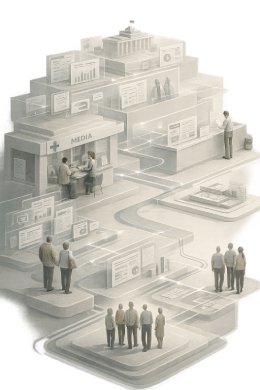
Trust acts as a filter through which media messages are interpreted. During a crisis, people rely heavily on media to interpret complex information and to signal which sources are credible. Before examining specific trust dynamics, it is important to note that trust is cumulative; it reflects past experiences with institutions, journalists, and authorities, not just current reporting.
Consistency and Credibility
Research consistently finds that consistent messaging increases trust. When media outlets present clear explanations that align with expert consensus, audiences are more likely to accept guidance and act on it. In contrast, contradictory reporting or frequent reversals undermine confidence, even if those changes reflect evolving evidence. Once trust is weakened, people become more likely to seek alternative sources, including unverified or misleading ones, which can fragment collective understanding.
The Role of Experts and Intermediaries
Media often serves as an intermediary between experts and the public. Studies suggest that when journalists accurately convey uncertainty and explain why guidance may change, trust is better preserved. Problems arise when experts are presented as either infallible or hopelessly divided. Oversimplification can create false certainty, while exaggerated conflict can give the impression that no guidance is reliable. Both outcomes affect how seriously people take rules and recommendations.
Rule-Following and Social Norms

Media does not just inform people about rules; it signals how others are behaving and what is socially expected. Before breaking this down further, it is useful to understand that rule-following is sectionly influenced by perceived norms rather than by rules alone.
Coverage that highlights widespread compliance tends to increase compliance itself. Behavioural research shows that people are more likely to follow rules when they believe most others are doing the same. Conversely, disproportionate focus on rule-breaking, even when rare, can normalise non-compliance. When audiences repeatedly see examples of violations without context, they may conclude that rules are optional or unfairly applied.
Digital Media and Accelerated Influence
The speed and reach of digital media intensify all of these effects. Information spreads rapidly, often without the editorial filters present in traditional outlets. Before listing specific dynamics, it is important to note that digital platforms blur the line between news, opinion, and personal experience.
- Algorithms tend to prioritise emotionally engaging content, which often amplifies fear-based messaging.
- Social sharing reinforces group norms, making beliefs and behaviours more uniform within communities.
- Misinformation can spread alongside accurate reporting, complicating trust and decision-making.
When Information Becomes Behaviour
Media plays a formative role in crises in shaping the basic behavior by influencing the extreme feelings of fear, trust, and their perception of social norms. Research from SR Journal (The Social Research Journal) shows that the very choice of the media affects not only what people know, but how they feel and behave. Such reporting, yet principled, consistent, and proportional, would evoke and strengthen trust and co-operation; exaggeration and inconsistency, on the contrary, would equally weaken these values.