

Every year, billions of pounds in benefits go unclaimed by people who are fully entitled to them. That is not a fringe problem. It represents a policy failure at scale, and a quiet financial crisis for households already stretched thin. People do not skip claiming because they do not need the money. Stigma, administrative complexity, fear of the system, and simple confusion stop them long before they reach an application form.
Non-Claiming Is More Common Than It Looks
In the UK, millions of pounds are left unclaimed annually in benefits- not because actual eligibility is nonexistent, but rather, people often fail to claim.
Take-up percentages vary dramatically from one benefit to the next. In 2021/22, for example, around just 63% of those entitled just to Pension Credit- the benefit aimed at the poorest older households- claimed the payment, thus losing an estimated £1.7 billion. A similar pattern emerges for Council Tax Support and Carer’s Allowance. Conversely, it’s the means-tested benefits- that is, those targeting those most vulnerable – which consistently show the lowest take-up.
The consequences are very real. Research from the Joseph Rowntree Foundation cites non-claiming directly feeds into escalating levels of debt, a decline in food well-being, and deteriorating mental health. Children from households that miss out on Child Tax Credit consequently are measurably worse off in educational outcomes. The programs for poor people cannot work if the people they target never gain access to them.
Now, it is not impossible to suggest that some of this gap might be explained by individual decisions. But this pattern is simply too strong, too concentrated on particular sets of people, to be entirely mopped up by that alone. System-level design and communication is doing most of the on-the-ground work.
Why People Hold Back Even When They Qualify
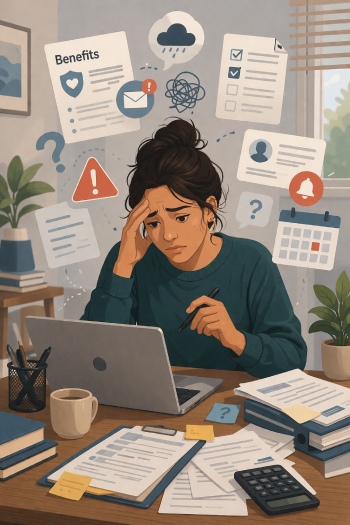
Shame is often the first barrier. Research by the Joseph Rowntree Foundation consistently finds that many working-age adults associate claiming benefits with personal failure, even when their circumstances – redundancy, illness, a relationship breakdown – are entirely outside their control. This sense of not deserving help stops people before they even look up the eligibility criteria.
Awareness is the second problem. A 2022 Policy in Practice analysis estimated that £19 billion in means-tested benefits goes unclaimed annually in Britain. Many people simply do not know a payment exists, or assume their income is too high to qualify.
Then there is the paperwork. Universal Credit applications can run to dozens of questions, require multiple proofs of identity and income, and demand digital access that not everyone has.
Fear compounds everything. Undocumented migrants worry that claiming will affect their immigration status. Others dread triggering a debt recovery process or losing a legacy benefit they rely on. These barriers rarely arrive alone – they stack.
What Research Shows About Behaviour, Messaging, and Trust
Behavioural science offers some uncomfortable answers about why eligible people stay away from benefits offices and online claim portals alike.
Present bias is part of it. People under financial stress tend to prioritise immediate, concrete problems over longer-term gains that require effort now. Filling out a complex Universal Credit application when you’re already exhausted is a real cognitive cost, not just an inconvenience.
Shame compounds this. Studies by the Joseph Rowntree Foundation consistently find that stigma around claiming remains powerful, particularly among working families who don’t see themselves as benefit recipients. Official messaging often reinforces this by framing support as a last resort rather than an entitlement.
The government has a marketing problem. Communications about benefits tend to be technical, impersonal, and implicitly targeted at “other people.” Research from the Behavioural Insights Team shows that simple, personalised messages significantly increase take-up rates.
Better Systems Would Raise Take-Up and Reduce Harm
Automatic enrolment is one of the most effective tools available. Where HMRC already holds income data, there is no principled reason why eligible households should have to apply at all. Scotland’s experience with the Best Start Grant, which uses existing data to pre-populate applications, points toward what becomes possible when agencies share information rather than guard it.
Simpler letters matter too. Research by the Behavioural Insights Team found that rewriting standard DWP correspondence in plain English measurably increased response rates. Long forms with ambiguous questions do not filter out fraud; they filter out the people the system is meant to help.
Proactive outreach, particularly through trusted local intermediaries like food banks and GP surgeries, reaches people who would never visit a government website. Offline access remains non-negotiable for older claimants and those without reliable internet.
Unclaimed benefits are not savings. They represent public spending that failed to reach its intended destination. When systems are needlessly hard to navigate, public trust erodes alongside take-up.
A Benefit Unclaimed Is Support Denied
It is not the case that people decide to stand in wait rather than receive help, except in very exceptional cases. They simply do not claim when they are eligible for a whole variety of reasons, some of which are stigma that makes it appear like a shameful thing to rattle off a request, systems so complex that they defeat even determined claimants, communication that has failed to reach the beneficiaries, and an equally massive, more or less worthy, total distrust of institutions. Over and over, research within the UK and beyond has shown that these are not failures on an individual level. Governments cannot, in so many words, design a benefit, prescribe it as available, and then be done with it. If the system is to genuinely attack hardship, it must be implemented in such a way that ordinary people can figure out how to access it, maneuver it around without extra help, and most importantly, be assured that making use of the system will not cost them elsewhere. The space between eligibility and claimants is not a mere anomaly. It is a failure of policy with real implications for real lives.